By Shaneka Jones

“Advocacy is not separate from teaching. It is part of how we serve children, support families, and strengthen the future of early childhood education”
Why NAEYC Stands Out
When I think about inspiring leaders in early childhood education, I do not only think about one person. I also think about organizations that consistently lead the field, support educators, and push for meaningful change for children and families. One group that stands out to me is the National Association for the Education of Young Children (NAEYC).
NAEYC is inspiring because its work reaches beyond offering resources. It helps shape what quality early childhood education looks like, strengthens the voice of educators, and reminds the field that advocacy is not optional. It is necessary. For those of us who work closely with children and families, that kind of leadership matters because it connects everyday practice to a larger purpose.
NAEYC promotes high-quality early learning for children from birth through age 8 and supports the profession through advocacy, professional development, accreditation, and educator resources (National Association for the Education of Young Children [NAEYC], n.d.). What makes this especially meaningful is that the organization does not focus on only one part of the field. It connects practice, policy, and professional growth in a way that reflects the real needs of early childhood education.
Contributions of NAEYC
One of NAEYC’s greatest contributions is its role in promoting high-quality early learning. The organization has helped define what developmentally appropriate practice looks like and why it matters for young children’s learning and development. This is an important contribution because early childhood education is sometimes misunderstood or undervalued. NAEYC helps bring clarity and credibility to the field by showing that early learning is both relational and academically important.
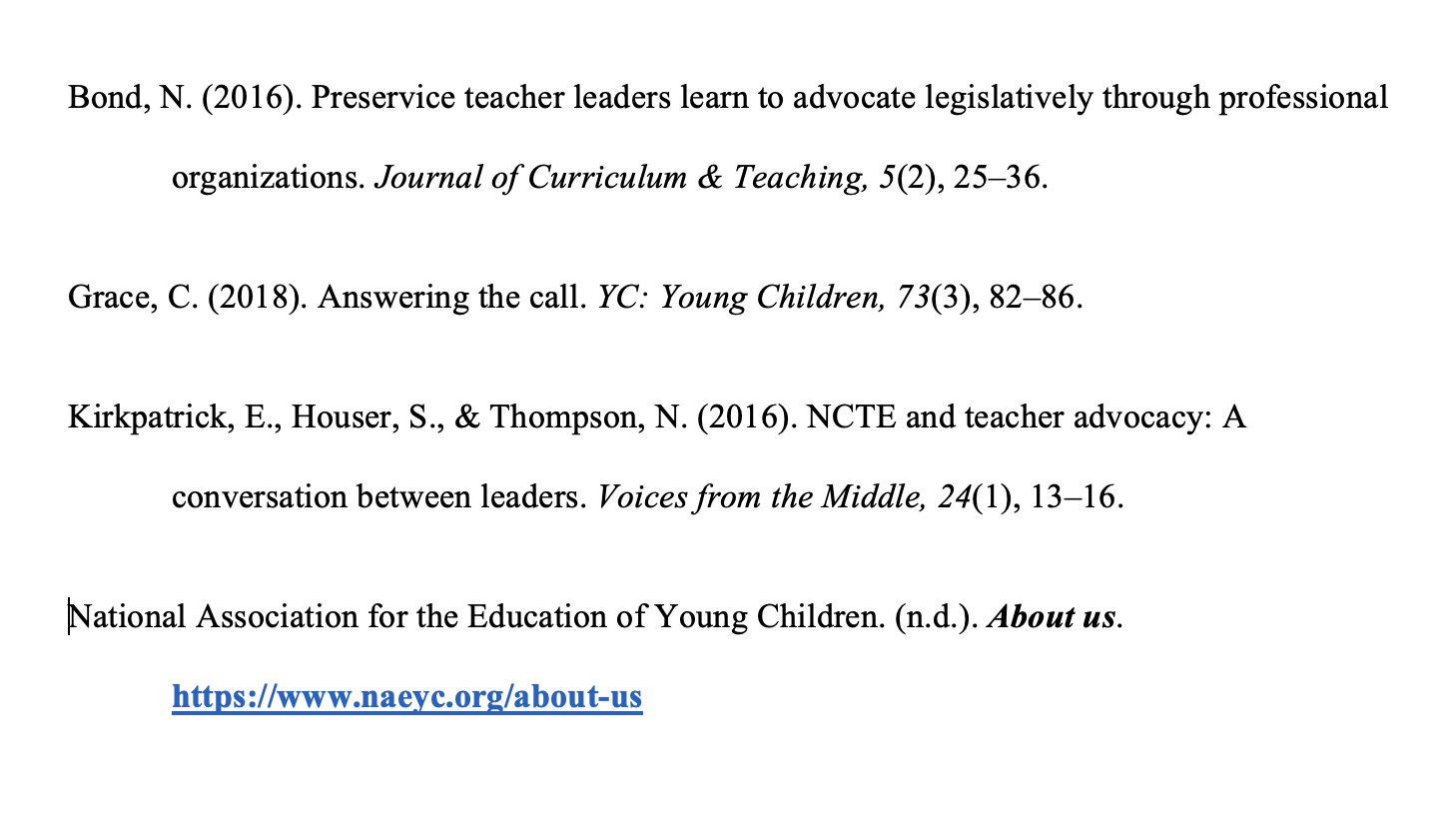
NAEYC has also made a strong contribution by supporting educator advocacy and professional growth. Through professional learning, publications, conferences, accreditation, and advocacy tools, the organization helps educators build both knowledge and confidence (NAEYC, n.d.). Bond (2016) explained that professional organizations can help educators grow in legislative and professional advocacy, especially when they learn how to connect their daily work to broader policy issues. That support matters because educators often know what children need, but they may not always feel prepared to speak into larger decisions that affect classrooms and families.
Another key contribution is NAEYC’s emphasis on family partnerships. In early childhood education, family engagement is not an extra. It is a necessary part of supporting the whole child. NAEYC’s work reinforces the idea that families should be respected as partners in children’s learning. In my own learning community and tutoring work, this is especially meaningful because I regularly see how much stronger student growth can be when families feel informed, included, and supported.
Leadership of NAEYC
NAEYC’s leadership stands out because it models consistency, purpose, and service to the field. Grace (2018) emphasized that advocacy in early childhood often begins with a willingness to answer the call to lead and remain committed even when the work is difficult. That idea connects strongly to NAEYC because the organization has remained a steady and respected voice in early childhood education for many years.
Its leadership is especially important because it does not treat advocacy as separate from practice. Instead, it shows that supporting children, strengthening families, and promoting quality instruction are all connected. Kirkpatrick et al. (2016) highlighted the role of professional organizations in helping educators see advocacy as part of their professional identity. I think that is one of the clearest ways NAEYC leads the field. It reminds educators that speaking up for children and families is already part of the work.
NAEYC also shows leadership by helping educators think beyond their immediate responsibilities. It encourages professionals to not only teach well, but also advocate for better systems, stronger standards, and more equitable opportunities for young children. That kind of leadership is inspiring because it combines vision with practical support.
Challenges NAEYC Faces
Even strong organizations face challenges, and NAEYC is no exception. One challenge is that having strong standards, advocacy tools, and professional guidance does not automatically guarantee strong implementation. Programs and educators may still face barriers such as limited funding, staffing shortages, and inconsistent institutional support. These realities can make it harder to fully apply the practices and principles NAEYC promotes.
Another challenge is that advocacy can sometimes feel distant from the everyday reality of educators who are already carrying so much. When teachers are focused on immediate student needs, advocacy may feel like one more responsibility instead of something that is already built into their role. This can make it harder for some educators to fully engage in broader advocacy efforts, even when they care deeply about children and families.
These challenges do not lessen NAEYC’s value. Instead, they show that advocacy work in early childhood is complex. Strong leadership and strong resources matter, but local programs, educators, and communities still need the time, support, and capacity to carry that work into practice.
NAEYC’s Impact on Others
NAEYC’s impact can be seen in the way it supports educators, children, and families. For educators, it provides professional tools, standards, and advocacy support that strengthen teaching and leadership. For children, it supports high-quality learning experiences that are developmentally appropriate and more equitable. For families, it reinforces the importance of partnership, communication, and respect in the learning process.
In my own learning community, that impact is especially meaningful. Much of my tutoring and literacy work involves helping children who need targeted support and helping families understand how to continue that support outside of direct instruction. Because of that, I see how much children benefit when learning is responsive and when families feel like active partners rather than outsiders. NAEYC’s work reflects those same values.
I also think NAEYC’s impact extends beyond individual classrooms or programs. It influences how early childhood professionals view their role, how quality is defined, and how advocacy is connected to everyday practice. That broader impact matters because children and families benefit most when the systems around them are also improving.
What Early Childhood Leaders Can Learn From NAEYC
There are several important lessons early childhood professionals can learn from NAEYC’s example:
Advocacy is part of the work. It is not separate from teaching, leadership, or family engagement.
Quality matters. Strong early learning experiences require intentional, informed practice.
Family partnerships matter. Children benefit most when educators and families work together.
Professional voice matters. Educators should not underestimate the value of their experience and influence.
Leadership must be sustained. Meaningful change in early childhood takes consistency, not quick fixes.
These lessons matter in my own work because I support children who need focused literacy help and families who need practical, clear guidance. In that context, advocacy means more than speaking about broad issues. It means helping children get what they need now while also pushing for stronger systems and opportunities around them.
Final Thoughts
NAEYC stands out as an inspiring leader in early childhood advocacy because it has consistently supported children, families, and educators while also strengthening the profession as a whole. Its contributions, leadership, and impact show what meaningful advocacy can look like in practice. At the same time, the challenges it faces remind us that strong advocacy requires not only vision, but also follow-through, partnership, and support at every level.
For me, that is what makes this topic so important. In my work with children and families, I see every day that advocacy is not abstract. It is personal, practical, and necessary. Organizations like NAEYC help strengthen that work by reminding educators that their voice, leadership, and commitment truly matter.